Pages

Wednesday, August 20, 2014

The Wednesday Review

Welcome to the first edition of the Wednesday Review!

I will be giving a spoiler-free review of a book or movie or something, always on a Wednesday.*

Today's review:


Season 1

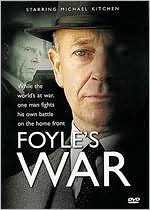
Introduction: Now past its seventh season (8th series, for my British readers), this lovely ITV British detective show set against the backdrop of World War Two stars Michael Kitchen as Detective Chief Superintendent Christopher Foyle.  With help from Detective Sergeant Paul Milner (Anthony Howell) and irrepressible driver Samantha Stewart (Honeysuckle Weeks - yes, that is her real name), Mr. Foyle investigates murder, sabotage, and other crimes on the home front.

Blah blah blah.

My Review: This is a fantastic show!  Nobody does detective stories quite like the British - the stories presented here are nicely layered, often involving multiple crimes which may or may not be related.  This makes it hard to guess 'who done it', which is always nice.  The crimes are more complicated than they appear at first, and motives and clues are scattered all over the place.  The stories (there are several in any given episode) are all wonderfully human.

Unlike many period pieces, everyone in this show looks like they stepped out of a 1940s photograph.  It's well directed, the writing is absolutely beautiful, and the acting is very natural and understated (my favorite - the kind that has you leaning forward mentally, wondering what's going on in the characters' heads).

The production values in this season are perhaps not what they could be, but they're not bad, either.  If you're looking for something fast-paced and glamorous, you'd better tune in to Sherlock.  If you want compelling stories, Foyle's War is the way to go.

Statistics:
Episodes in the Season: 4
Episode Length: 98-100 min
Episode Names: The German Woman, The White Feather, A Lesson in Murder, Eagle Day

My Rating: 4.5 stars (out of five)


*Doctor Who Paraphrase: "Every Wednesday?"  "No.  But any Wednesday."

Monday, August 18, 2014

Uninspired and Addicted to Books

There is nothing inspiring about selling a house.

If, like my dad, you're good at landscaping, I suppose it could be an opportunity to create landscape art in the name of curb appeal.

If, like my mom, you're good at interior design, you could potentially flex your creative muscles in a bid to make the inside so welcoming that your buyers insist on keeping all the furniture and accessories (this actually happened once).

I have neither of those skills.  The height of my house-selling creativity has been applying touch-up paint to scuffs on the walls.


I've been taking refuge at Barnes and Noble whenever my realtor needs me out of the house, which is a dangerous thing to do.  I was there for a few hours yesterday, and I was absolutely determined to not buy anything except my lunch.  I was going to completely avoid temptation by not even looking at any books or DVDs.  I even took my netbook to work on a writing project so I wouldn't get bored.

Unfortunately, I brought the wrong cable and couldn't plug it in.

So I got bored.

I played it fairly safe.  I stopped by the reference section.  I glanced at the plays.  I flipped through a couple books about television shows.  I meandered over to the poetry section.  I picked books up and put them back down.  I read bits and pieces and set them aside.  I was doing very well.

Then I started skimming The Mousetrap And Other Plays by Agatha Christie.  And after that I saw the copy of Beowulf as translated by J.R.R. Tolkien, which I'd heard was coming out back in June at the Glen Workshop.

I didn't stand a chance.  I bought them both.

On the plus side, I did get an idea for a Beowulf-related story while reading that book's introduction.  So, basically, I can justify that purchase by calling it research.  As for the Agatha Christie volume...character study.  Yes.  You see?  Research again.  A legitimate, even necessary expense.


Don't judge me.  :)

Saturday, August 16, 2014

Manifesto

I have no business blogging.

I'm not funny on paper, my pop-culture reference skills are limited, I'm not famous, and I don't have a ridiculous project to chronicle.  If you are interested in consistently snappy writing, beautiful photos, recipes, and the like, I suggest you look elsewhere.

If you're still reading at this point, you're probably a friend or relation.  Or bored.

If you are in the 'bored' category, you may find more to amuse you on a well-established blog.  Just sayin'.


Still here?  Well.  Bored and persistent.  I like your follow-through.


So!  My manifesto.  Right.

According to dictionary.com, a manifesto is 'a public declaration of intentions'.


MY INTENTIONS:

1. To remember that this is a blog, not a class, and should therefore be fun, not, you know, boring.

2. To chronicle the intersection of life and art, as I experience it.

3. To review books and movies, etc.

4. Four is a rubbish number. I'm skipping four.

5. To make as many lists as possible. Because reasons.

6. To have an outlet for nerdiness.  So when my family gets tired of me talking about things like Doctor Who, I have a refuge.

7. To have a blog.  Obviously.


So there you have it.  My blog manifesto.  Ha.  I feel like I have been exceedingly productive.  Now I can go procrastinate whatever I should be doing next.

Tuesday, May 13, 2014

How I Work

On one of the back burners of my brain, I've been thinking about how I work, by which I mean, the conditions I like to work in.  It all started when I read a Meme on Facebook (can you believe it?), and I started noticing little preferences I had about my workspace.  When I sat down to scribble (read: type) out a thought about this phenomenon, it quickly spiraled downhill into a blog post:

Where do I write?  Theoretically, I can write anywhere, especially here in the computer age.  And I have.  I’ve written at home, in various parts of my home.  At work (only a couple times, when it was slow).  In my high school math class (when I was finished with my work – see?  I’m a good kid – really!).  During breaks at a briefing.  On my computer, my laptop, my netbook.  In a restaurant.  At Starbucks, naturally.  At Barnes and Noble.  On a walk.  On the subway.  In the car (once #hazardous, #don’ttrythisathome #SoRidiculousI’veResortedToUsingHashtags).  On the train in Germany.  At my various residences prior to the current one.  In the park.  In the yard.  In hotel rooms.  Etc.

Still, when it comes to serious, intentional, prolonged writing, a good, specified work space is a beautiful thing.  In the past, this was B&N or Starbucks, because I didn’t have a good space at home, but one can’t go to these places and purchase food and hot chocolate and Nantucket Nectars every day.  One would go broke.  Thankfully, I now own a lovely house with some architectural character, and I turned the dining room into my studio.  I have surrounded myself with beautiful things – my paintings from Afghanistan and Jordan and various other travels.  A nice display case with the artsier souvenirs from my own travels and those of family members.  And of course, my writing desk.  It’s gorgeous, and I refuse to put a computer on it – the entire surface is available to me to sprawl my notebooks, notecards, papers, pens, pencils, highlighters, books, awesome owl bookends for my most treasured art-and-God books, and my elbows; underneath is also clear, for unrestricted leg room no matter what angle I’m sitting at.  It’s wonderful.  It tends to get cluttered.

Clutter is fine.  It can be remarkably satisfying to survey a nice, productivity-caused clutter.  But leave it that way, and I find myself avoiding the desk.  So, a lesson I have learned about myself: I need a clean, organized surface to start work.  If I’m to sit down at the dining room table (where I find myself doing all of my poetry editing), the entire table must be clean and cleared of any non-poetry related stuff.  To sit and compose correspondence or write something new, my studio writing desk must be neat and tidy.  Right angles and all that, with sufficient space for my notebook and elbow-room.  Although I enjoy organization in it's place, I’m not at all a neat-freak, so I find this very interesting.

And what about time of day?  I am my most creative from the evening to the middle of the night, but that could be as much a product of my work schedule as it is of my life-long night owl tendencies.  At any rate, a nice creative prompt can help alleviate this tendency; can pull the opening hours of reflection closer to mid-afternoon.

Reading is the best prompt, because just about any genre can get the creative juices flowing, as long as it’s not on a computer.  Computers are distracting and screens are unimaginative.  Hard-copy books are portals.  Some movies or other multi-media can be very inspiring, as well, but most are just brain-suckers - great for relaxing, not inspiration.  Music can be very helpful, depending on the style, content and volume.  And listening to a good sermon, for example, can give lovely insights that may be applicable to what I’m writing, or just get the brain ticking, which is always good.  Reading the Bible does much the same, besides also having an unmatched ability to restore the mind and soul, among its other qualities.  And prayer.  Prayer is one of those things that seems intangible until you get a direct answer.  I find it very helpful to pray about my writing – I may not pen something five minutes after praying, but it always makes me open, which leads to writing sooner or later.

These are some of the things I’ve noticed about my habits as I turn my attention more and more toward serious writing.  I'm curious if others have such finicky preferences.  Somebody should do a study...

Tuesday, April 8, 2014

Self-Publishing: A Few Lessons Learned

If it's been a while since I've blogged, it's because I've had a lot going on.  Work has kept me busy, I switched to night shift a couple times, I got a stomach bug, etc, etc.  And of course, I'm working on my book!  It's been quite the process, and I thought I'd share a few things I've noticed about the self-publishing process, as I have experienced it thus far:


1.  It takes FOREVER.  However long you think it's going to take you, times it by 10.  Or 100.

2.  Being professional means making time and money commitments.  Authors these days are active on social media, so I must be as well.  Authors need professional photos, so I had some taken.  A free-lance author must market their own work, so I have been doing research.  The list goes on.

3.  Better get lots of eyes on your work and be as self-critical of your writing as possible.  You want to ensure that the best work you are capable of creating (without the wisdom and assistance of editors) ends up for sale, not just some hodge-podge that was "good enough".

4.  Know your work and what you're going for, and stick to that ruthlessly.  Be decisive, and be confident in what you're doing.  My poetry book has a theme, and it's important that all the poems in the book are related to that theme.  It's also important that all the poems are of a similar quality; you don't want a really good poem you wrote a few months ago right next to a truly awful one you wrote in high school.  I've had to take poems out, add poems in, and make edits, all in the name of consistency.

5.  Don't be shy.  Talk to people who have self-published.  Send your stuff out there.  Let people know you're Creating Art.  Completely buy into your new endeavor.


I'm still learning all these things, but those are my top five lessons so far.  I'm sure there will be more...